
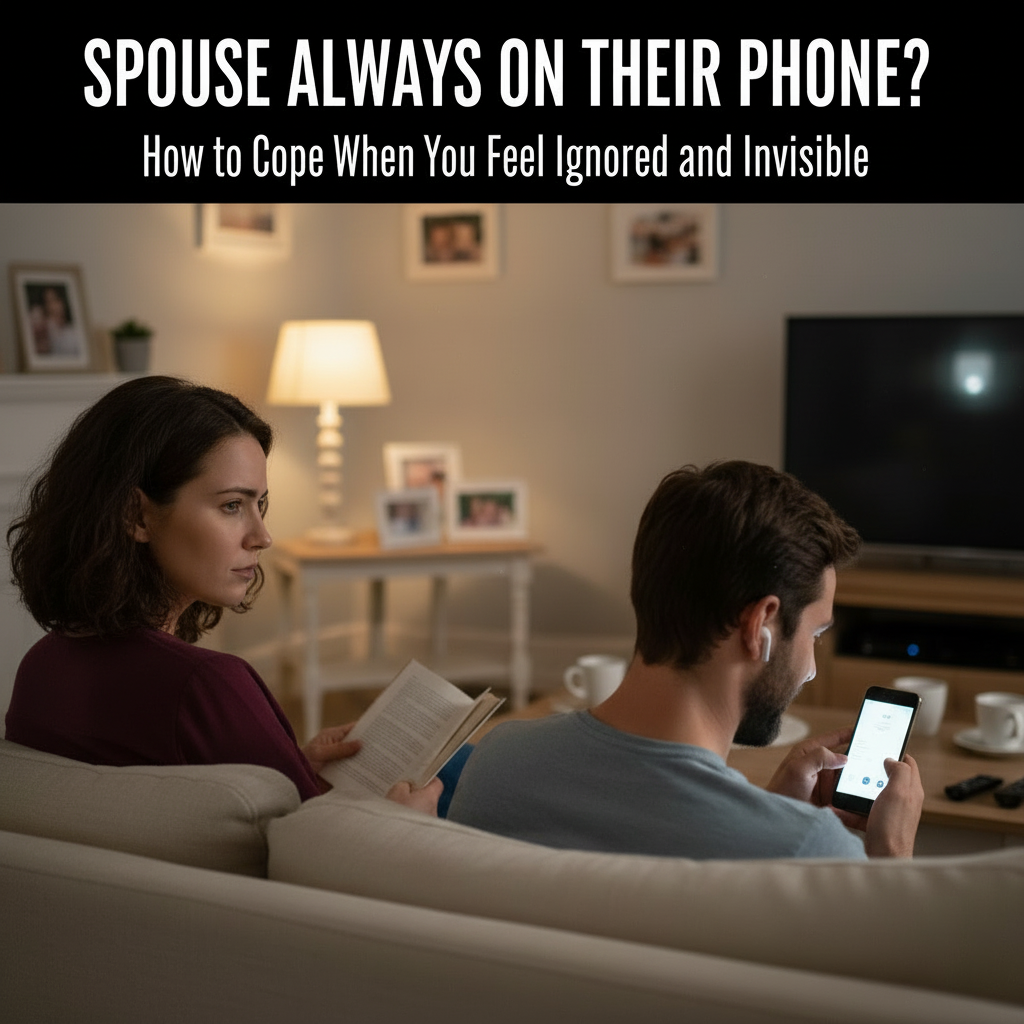
How to use the LOWER Method to reduce “phubbing” frustration and rebuild real connection
Why this kind of frustration hits so hard
Phones are supposed to make life easier. But in a marriage, they can quietly become a third person in the room.
It often starts small – checking a message during dinner, scrolling while you talk, “just one more minute” in bed. Over time, it can feel like you’re living beside your spouse, not with them.
And the most painful part is how confusing it is. You’re not asking for a grand romantic gesture. You’re asking for eye contact. Presence. A few minutes of undivided attention.
If you’ve been sitting on the couch feeling lonely while your spouse scrolls, you’re not being dramatic. Research has linked partner “phubbing” (phone snubbing) with lower relationship satisfaction and increased loneliness.
This article will help you lower the emotional heat and address the problem without turning it into a fight – using the LOWER Method: Label, Own, Wait, Explore, Resolve.
What “phubbing” does to a relationship (Even when nobody means harm)
When your spouse is on their phone, your brain often interprets it as a signal:
- I’m not interesting.
- I’m not important.
- I’m alone in this marriage.
- I have to compete for attention.
Your spouse may not intend any of that. They may be decompressing, avoiding stress, numbing out, or stuck in habit loops.
But impact matters. When the pattern repeats, the emotional result is predictable: irritation turns into resentment. Resentment turns into distance.
And then you get the truly frustrating experience of being “together” all the time, but connected almost never.
Why standard advice doesn’t always work
If you’ve searched this topic before, you’ve probably seen:
- “Set boundaries – no phones at dinner.”
- “Communicate your needs.”
- “Schedule quality time.”
- “Do date nights.”
Those can help. The problem is timing.
If you try to enforce a boundary while you’re already hurt (“Put your phone away!”), it often triggers defensiveness. If your spouse feels controlled, they double down. If you feel ignored, you press harder. And suddenly the phone isn’t the issue – the fight is.
This is where the LOWER Method helps: it lowers your emotional intensity first, so your request lands as a bid for connection, not an accusation.
The LOWER Method for Phone-Driven Marriage Frustration
1) Label
Start by naming what’s happening in specific terms.
Use this phrase:
“That’s frustrating when…”
Examples:
- That’s frustrating when I’m talking and you keep scrolling like I’m background noise.
- That’s frustrating when we finally have time together and it gets absorbed by your phone.
- That’s frustrating when you’re physically here but mentally somewhere else.
Why this matters: labeling turns a vague anger (“you don’t care”) into a clear moment (“this behavior makes me feel disconnected”).
2) Own
Now shift from blaming the person to owning the feeling.
Use this phrase:
“I feel frustrated when…”
Examples:
- I feel frustrated when I’m trying to connect and I can’t get your attention.
- I feel frustrated when our evenings turn into parallel scrolling instead of together time.
- I feel frustrated when I’m lonely right next to you.
Owning doesn’t excuse the behavior. It prevents the conversation from starting with a character attack.
This is the difference between:
- “You’re addicted to your phone.”
and - “I’m feeling lonely and disconnected lately.”
The second one has a chance to be heard.
3) Wait
This step is simple, but it’s often the difference between progress and another argument.
Don’t confront it in the peak moment.
If you’re already irritated, your tone will carry it – even if your words are “nice.” You’ll sound like a prosecutor, not a partner.
Waiting might look like:
- taking 3 slow breaths before speaking
- leaving the room for 5 minutes to reset
- choosing a calmer time later that day
If your nervous system is flooded, you’re unlikely to communicate well – and your spouse is unlikely to respond well. Gottman’s work commonly references taking a break and allowing time for physiology to calm before continuing a difficult conversation.
Waiting is not ignoring the problem. It’s creating the conditions where the conversation can actually work.
4) Explore
This is the step that prevents your frustration from turning into moral judgment.
Here are 4 constructive Explore options to try:
Explore Option 1: Identify what you’re
really
needing
Ask yourself:
- Is it attention? affection? conversation? teamwork?
- Do I want less phone time – or more us time?
This keeps the goal focused: connection, not control.
Explore Option 2: Consider what the phone is doing for your spouse
Phones often serve a purpose:
- decompression
- avoidance of stress
- stimulation when life feels repetitive
- habit-driven dopamine loops
This doesn’t make it “fine.” It makes it understandable, which helps you approach the issue with more effectiveness and less contempt.
Explore Option 3: Track the patterns
Look for when the scrolling is worst:
- after work? after conflict? late at night? during family stress?
Patterns point to solutions. For example, if the phone spike is after work, maybe your spouse needs a 10-minute decompression buffer before they can be present.
Explore Option 4: Notice your own coping moves
When you feel ignored, do you:
- get sharp and sarcastic?
- withdraw and go cold?
- pursue harder and escalate?
- scroll too, as a form of protest?
Not to blame yourself – but to understand the loop you’re both stuck in.
If you want another useful companion tool here, read:
Stop Absorbing Negative Emotions From Others: Use the LOWER Method To Stay Calm
It helps when your spouse’s mood (or distracted energy) starts pulling you into reactivity.
5) Resolve
Now you act – calmly, clearly, and with a specific request.
A simple script that works better than “get off your phone”
Pick a neutral moment (not during scrolling), then try:
“I’ve been noticing something, and I want to bring it up gently. I’ve been feeling disconnected lately. When we’re together and the phone is out, I feel frustrated when I can’t really get your attention. I’m not trying to control you – I’m trying to protect us. Could we try one small change this week?”
Then offer one small, concrete option:
- No phones at dinner
- Phones on the charger from 9–10 pm
- A 20-minute “check-in” after work with phones away
- One screen-free walk together a few nights a week
Small changes beat big speeches.
If they get defensive
Your job is to stay anchored:
“I hear you. I’m not saying you’re a bad person. I’m saying I miss you – and I want more of us.”
That line is hard to argue with.
Reinforce the wins
When they do show up, name it:
“Thank you for being present tonight. I felt closer to you.”
That’s not manipulation. It’s emotional reinforcement – and it tends to grow the behavior you want.
If you’re also feeling stuck in repeated arguments about connection, this related article can help you shift the communication pattern first:
“You Never Listen!” – How to Be Heard and Understood When Communication Breaks Down
What if your spouse says: “I’m not on it that much”
This is common. People often underestimate screen time because it’s fragmented.
Instead of arguing data, return to impact:
“I’m not trying to count minutes. I’m telling you how it feels on my side.”
Research consistently finds phubbing is associated with relationship harm through loneliness and lower satisfaction – so you’re not making up the emotional effect.
3 relevant external resources (for readers who want the research)
- Gottman Institute on taking breaks and calming flooding during conflict:
- Frontiers in Psychology (2022) on phubbing, loneliness, empathy, and relationship satisfaction:
- Research summary on partner phubbing reducing commitment via loneliness and satisfaction (2025, PMC):
FAQ
Is it normal to feel frustrated when my spouse is always on their phone?
Yes. Feeling frustrated or disconnected when your spouse is frequently on their phone is common. Emotional presence is a basic relationship need, and repeated distraction can trigger loneliness, resentment, and feeling unimportant.
How do I talk to my spouse about phone use without sounding controlling?
Focus on your feelings rather than their behavior. Using statements like “I feel frustrated when…” helps communicate the emotional impact without blaming. Lowering emotional intensity first increases the chance your spouse will hear you rather than become defensive.
What if my spouse says their phone helps them relax or unwind?
That can be true. Many people use phones to cope with stress or mental overload. Acknowledging this does not invalidate your need for connection. Healthy relationships balance individual coping habits with intentional, phone-free time together.
What should I do if nothing changes after I bring it up?
Change often happens gradually. Start with small, specific requests and notice incremental improvements. If repeated calm conversations lead to continued frustration or emotional distance, couples counseling can help address deeper patterns and restore connection.
A final reminder: this is about connection, not control
If your spouse is glued to their phone, the real pain usually isn’t the screen.
It’s the feeling that you’re no longer the priority.
That hurt builds quietly. It shows up as sarcasm, withdrawal, tension, or resignation. And over time, it can convince you that asking for attention is asking for too much.
It isn’t.
What does backfire is trying to fix the problem while you’re flooded with frustration. That’s when the request turns into an accusation and the phone becomes a battleground instead of a boundary.
The LOWER Method gives you a different path:
- You slow down instead of snapping
- You clarify your feelings instead of attacking
- You speak from connection instead of resentment
That shift alone often changes how your spouse hears you.
You may not fix this in one conversation. But each calm, clear request resets the pattern a little. Each moment of presence you protect makes the relationship feel safer again.
Phones don’t destroy marriages.
Unaddressed disconnection does.
Lower the frustration first. Then protect what actually matters.
If you want more tools like this for everyday marriage stress, follow That’s Frustrating and keep using the LOWER Method where frustration shows up next.





Leave a Reply